
#010 Vending Machine Business
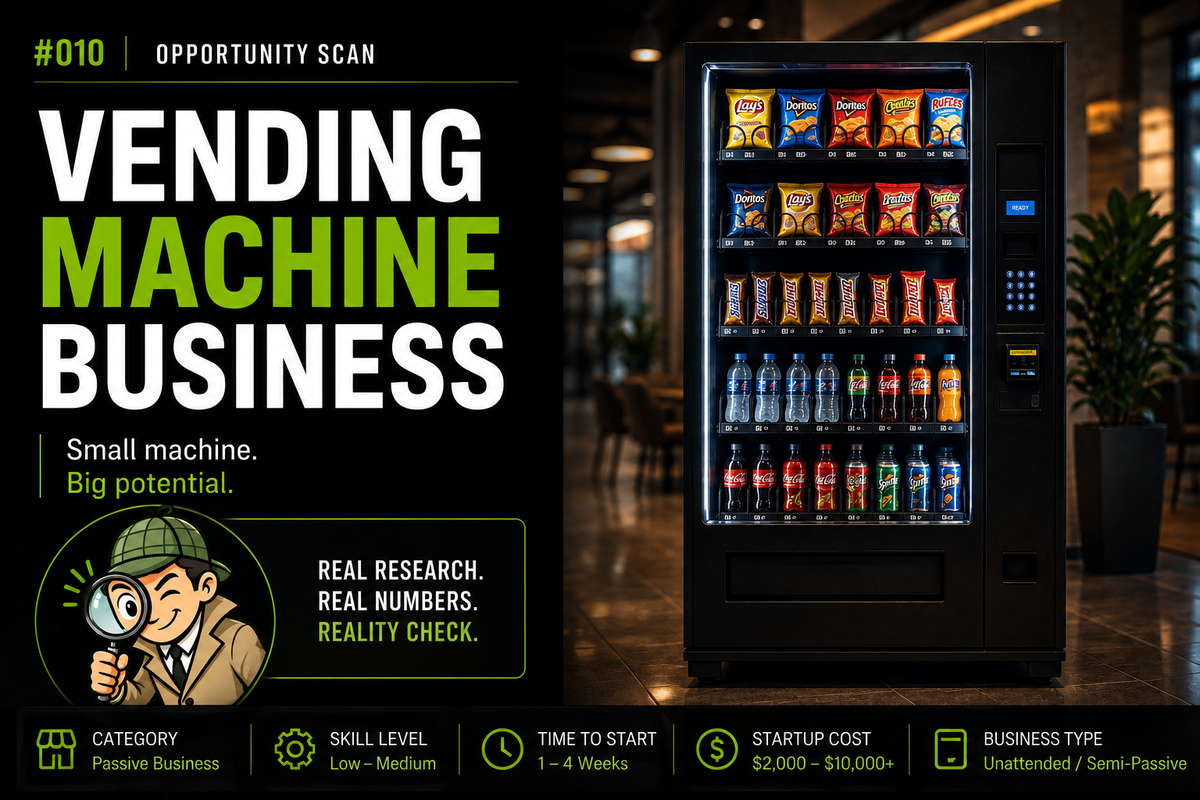
The Vending Machine Business Is Not About the Machine
Why location sales, route density, and disciplined service matter more than the passive-income pitch.
Central finding: Vending is not primarily a machine business. It is a local sales-and-distribution route whose economics depend on location quality, geographic density, and consistent service.
I began this investigation with a fairly generous version of the usual vending-machine pitch. I assumed that “semi-passive income” was mostly an exaggeration placed on top of a genuinely low-effort business: buy a machine, find somewhere to put it, refill it occasionally, and collect the difference between wholesale and retail prices. The exaggeration, I thought, was the word passive. The underlying model still seemed simple.
What changed my mind was not a complicated financial model. It was the way actual operators described their weeks. One owner, a year into the business with two locations, listed the ordinary work: restocking, checking expiration dates, making repairs, and handling sales-tax bookkeeping. Across other accounts, the same pattern kept returning. The machine did not remove the work. It merely organized the work into a route.
That distinction matters because it changes what kind of opportunity this really is. Vending is often presented as a retail business in miniature, but the evidence points somewhere else. It is better understood as a local sales and distribution business in which the operator must win access to foot traffic, maintain equipment, manage inventory, and travel efficiently between locations. The machine is visible. The business behind it is not.
The location is the product
The first recurring lesson was that location quality dominates almost everything else. Independent sources repeatedly treated it as more important than the brand of machine, the product mix, or small pricing adjustments. A well-built machine in a weak location is still a weak asset. A basic but reliable machine in a strong location can outperform it because the operator is not primarily selling snacks. The operator is monetizing convenient access to people who are already there.
Economically, the arrangement resembles a small form of rent arbitrage on foot traffic. The host provides a few square feet in an office, warehouse, apartment building, gym, laundromat, or similar venue. In exchange, the operator may pay a commission, often described in the research as roughly 5% to 25% of gross sales. The operator then earns a margin by serving purchases that occur because leaving the property is inconvenient. What looks like a product business is therefore built on access to a place.
This also explains why the attractive version of vending is hard for a new independent operator to enter. Universities, hospitals, and major retail properties are not empty territory waiting for someone with a machine. Many are already controlled through exclusive agreements with large beverage or vending companies. The research notes included an example of a university beverage contract worth more than a small operator could plausibly compete against. The locations that appear most obvious on paper are often the least available in practice.
A beginner is more likely to compete for smaller offices, gyms, apartment complexes, auto shops, warehouses, and locally owned businesses. These can still work, but their economics are less automatic. Traffic may be lower, demand may vary by shift or season, and the host may still expect a commission. This makes site selection a sales problem before it becomes an operations problem. An operator has to identify a plausible location, reach the decision-maker, explain the value, negotiate the terms, and absorb rejection. One new operator in the research set a goal of collecting one hundred rejections before expecting a yes. That is a more honest picture of the entry barrier than the usual image of buying a machine first and finding a home for it later.
Small scale creates a job; density creates a business
The second lesson was that scale changes the character of the model, but not in a smooth or comfortable way. At very small scale, vending can produce supplemental income. It can also become a respectable side hustle for someone willing to perform the route work personally. What it does not resemble is passive ownership.
One route-economics analysis in the research estimated that an owner with roughly five to ten machines might generate about $8,000 to $25,000 a year in owner cash flow after valuing personal labor at an ordinary wage, with several hours of route work each week. That can be worthwhile. It is also close to the economics of a paid part-time job. The operator is earning because the operator is driving, carrying inventory, cleaning machines, resolving problems, and keeping locations satisfied.
The margin at the machine level is thinner than the markup suggests. A snack bought cheaply and sold for much more creates the impression of extraordinary profitability, but gross markup is not net profit. The research included an example of a machine producing $500 in monthly sales and about $119 in actual profit after product cost, host commission, card fees, fuel, spoilage, repairs, and insurance. That works out to a margin of roughly 23.8%, before charging anything for the owner’s time. The lesson is not that every machine will produce exactly that result. It is that the visible difference between wholesale and retail price hides most of the cost structure.
The awkward point arrives around the middle. A route of twenty to thirty machines may require roughly fifteen to twenty-five hours of weekly driving and service, depending on how the locations are spread out. That is too much to feel passive and often too little to support a full-time driver without weakening the economics. The owner can become trapped between a side hustle and a managed business: too large to service casually, too small to delegate comfortably.
Only at larger scale does the model begin to change again. Around fifty or more machines, a sufficiently productive and geographically concentrated route may justify hiring a driver. At that stage, the owner can move away from filling machines and toward managing locations, inventory, staff, repairs, and cash flow. Even then, the owner has not escaped operations. The work has shifted from route labor to route management.
This is why route density matters almost as much as location quality. Ten decent machines clustered within a few miles can be more valuable than ten stronger machines scattered across a wide area. Every trip has a fixed cost in time, fuel, loading, and interruption. When one stop sits close to the next, those costs are shared. When the route is scattered, each machine carries more of them. The business becomes scalable only when revenue grows faster than the burden of reaching and servicing the locations.
The passive-income promise hides an operating system
Once the route is visible, the operating burden becomes easier to understand. Inventory has to be bought, transported, stored, rotated, and matched to demand. Products expire. Machines jam. Bill validators fail. Refrigeration systems break. A location that runs empty loses sales; a location stocked with the wrong products creates waste. The operator is not simply refilling shelves. The operator is running a small forecasting and maintenance system across multiple remote points.
Service discipline also protects the relationship with the host. The research repeatedly linked failure to neglected locations: machines left empty, expired products, slow repairs, and operators who stopped visiting consistently. A machine can survive a technical problem. A host may not tolerate an unreliable operator. Once trust is lost, the asset is not just the equipment. The location itself can disappear.
Cashless payment adds another layer. In the 2026 research notes, experienced operators treated tap-to-pay as a baseline expectation rather than an upgrade. A machine without it may be harder to place and less useful to customers who no longer carry cash. Yet the card reader creates its own recurring work: connectivity problems, dropped transactions, firmware issues, remote resets, and vendor support. Cashless capability improves the offer while turning software and signal reliability into part of the maintenance schedule.
Regulation is less visible but potentially just as important. Requirements vary by state, county, and city, but the research surfaced examples involving health-department permits, sales-tax registration, inspections, and an approved base or commissary for restocking. San Francisco’s health code, for example, requires vending-machine operators to apply for a permit. The specific obligations in Maryland and Baltimore were not resolved in the source material, so they remain a necessary local follow-up rather than a detail that can be assumed away.
Taken together, these tasks do not make vending uniquely difficult. They make it ordinary. It is a real small business with sales, logistics, maintenance, compliance, and customer-service responsibilities. The unusual part is how often those responsibilities disappear from the marketing.
Where beginners are most exposed
The machine itself may not be the largest risk. The route-resale market appears to be more dangerous because it attracts buyers who want to skip the hardest part: finding good locations. That desire creates an ideal environment for inflated machine prices, vague earnings claims, guaranteed-location promises, and pressure to pay before inspecting the assets.
The research notes included a dedicated vending-scam guide that described recurring warning signs: sellers who cannot provide keys, cannot document earnings, refuse to show machines without a deposit, or promise locations as though host relationships were permanent property. The guide estimated that a large share of route listings on general marketplace sites may carry fraud risk. That estimate should not be treated as a measured industry statistic, but the pattern is still useful. The more a seller emphasizes passivity, guaranteed income, or effortless placement, the more carefully the buyer should verify the underlying locations and revenue.
Failure-rate claims require similar caution. Industry estimates cited in the research ranged widely, from roughly 30% to 70% of operators quitting within eighteen to twenty-four months. The range is too broad to use as a precise forecast. It does, however, point toward a consistent explanation in the underlying commentary: poor site selection, weak service discipline, and unrealistic expectations. The model can work while still disappointing many entrants because they purchased equipment before proving that they could acquire and retain productive locations.
There is also a survivorship problem in the available evidence. Detailed route economics often come from operators who remained in the business long enough to discuss it, or from analysts who built content around successful routes. The people who quit may leave fewer records. That does not invalidate the reported economics, but it means a prospective owner should treat them as scenarios rather than promises.
A realistic test for a normal person
For someone with a full-time job, a family, and limited capital, vending can still be a legitimate opportunity under narrow conditions. The most realistic version is not replacing a salary. It is building a small route that produces supplemental cash flow and has a clear ceiling on the owner’s time. A handful of machines may be manageable if the locations are close together, the machines are reliable and cashless-capable, and the operator accepts that several hours each week belong to the route.
The correct first purchase, however, may be no machine at all. The research suggests testing the bottleneck before buying the asset. A prospective operator could identify fifteen to twenty realistic local targets—small offices, apartment buildings, gyms, warehouses, or auto shops—and spend a month calling or visiting them. The goal would be to learn how many decision-makers are reachable, how many are interested, what commissions they expect, and what objections appear repeatedly.
That test is valuable precisely because it is uncomfortable. It reveals whether the person is willing and able to do the part of the business that cannot be outsourced to the machine. Someone who dislikes cold outreach, negotiation, driving, inventory handling, and routine maintenance will not be rescued by attractive unit economics. Someone who can win and keep locations may have something worth building.
If the sales test produces a credible location, the next step is a single cashless-capable machine operated for sixty to ninety days. The operator should track not only revenue and product cost, but every hour spent driving, buying stock, loading, restocking, cleaning, troubleshooting, bookkeeping, and communicating with the host. That record converts the idea from a passive-income story into a measured local business. Scaling should come only after the first machine demonstrates both demand and a tolerable workload.
Conclusion
The investigation did not show that vending machines are a bad business. It showed that the machine is the least informative part of the business. The opportunity exists in acquiring access to dependable foot traffic, servicing locations consistently, and concentrating enough productive machines into a route that travel and labor become efficient.
At small scale, the model is best understood as a paid side job with equipment attached. At middle scale, it can become an operational trap unless the route is unusually dense and productive. At larger scale, it may become a managed cash-flow business, but only after the owner has solved sales, location quality, service discipline, and delegation.
The passive-income pitch reverses this order. It asks the buyer to focus on the machine because the machine is easy to photograph, price, and sell. The real work happens before and around it. A vending business becomes attractive not when someone owns machines, but when those machines sit in the right places, close enough together, under the care of an operator who treats the route as a business rather than an appliance.
Research boundary
This essay was developed from the supplied research notes. The notes did not resolve Maryland- or Baltimore-specific licensing requirements, and the cited operator attrition estimates were broad and methodologically uncertain. Those points are therefore presented as open questions rather than settled conclusions.